Showing posts with label 6mm Napoleonics. Show all posts

Monday, 8 June 2020

Portuguese line infantry and cacadores in 6mm

As a continuation of my current Peninsular project I have this week completed a further two regiments of Portuguese infantry - the 5th Line (First Elvas) and the 2nd Cacadores regiments. Both regiments belonged to the Second or Centre Division and carry the distinctive white standard.

All figures are from Baccus as usual. I am now close to my 24 stand target for the Portuguese, with only four stands to go. At 20 stands strong, they are now the equivalent of a 7,200 force on table in Age of Eagles terms. I cannot say that I am pleased with my progress - it is quite possible to be much more productive when painting 6mm figures but I have other life stuff going on which obviously take away precious painting time. This week I hope to wrap up painting figures and concentrate on a few terrain items.

This post has been cross posted to the Analogue Hobbies Quarantine Challenge blog.

Cheers all!

The two regiments completed this week
2nd Cacadores
5th Line Infantry
The full Portuguese complement


Sunday, 31 May 2020

1808 Spanish and Portuguese units in 6mm

I've been busy adding more 6mm figures to my Peninsular forces these past weeks and managed to finish a decent amount of Spanish and Portuguese units for my upcoming Albuera refight. All figures are from Baccus as usual and I still have a few Portuguese units to go before I can stage the battle. I also put in a few Spanish command stands - a couple of Portuguese commands will be added later.  I plan to include a few British officers in these to reflect the British training and equipping of the Lusitanian troops.


Five Spanish line regiments plus some irregulars/militia (bottom right) and command stands in front
The 4th, 10th & 14th Portuguese line regiments 
The combined force, Portuguese on left and Spanish on right
I hope to add some cacadores this week or the next and wrap up the remaining 12 Portuguese stands that I need for the refight. I will put them up on the blog as soon as complete.

Until then keep healthy everyone.


Saturday, 2 May 2020

Baccus 6mm Spanish units

Following last week's Mediterranean BUA's I got the urge to continue with my Spanish 6mm army so I fished them out of the war chest and painted up a few units, more precisely six foot artillery batteries, the Maria Luisa hussars, Regimiento del Rey heavy cavalry, Lusitania dragoons and Zaragoza line infantry.  All units are painted with 1808 uniforms and are based for Age of Eagles.

Six foot batteries and Maria Luisa hussars

Red dolman and Sky Blue pelisse for the hussars - very colourful uniforms!

The artillerymen are no less colourful in their blue uniforms with red facings and blue grey guns
Rey heavy cavalry on left, Lusitania dragoons in the centre and Zaragoza line infantry on right
Infantry flags from Baccus, cavalry standards are hand painted
The Zaragoza regiment kept their 1802 blue uniforms, unlike the usual white for the line infantry
And a final group picture of the whole lot

Next week I will be pressing on with more Spanish units with a solo replay of Albuera in mind sometime in the future.

This post is being cross posted in The Analogue Hobbies Quarantine Challenge blog

Good health to all

Friday, 27 December 2019

Peninsular Spanish in 6mm

To complement my British Peninsular units I am mustering some Spanish and Portuguese units.  Actually, the word 'some' is a bit of a misnomer since the unpainted lead I got recently from Baccus is anything but ! Anyway, this week I got eight Spanish infantry stands off the painting desk, just shy of a hundred figures, representing the 7th 'Zamora' line regiment with black facings and the 8th 'Soria' regiment with purple facings. I am not aiming for any particular historical scenario so I am choosing units at my whim.  Unfortunately Spanish army organisation was quite chaotic between 1805 and 1812 and OOB's are rarely complete and accurate so it is quite useless to invest too much time in researching in too much detail as very often there is none to be found ! I am mostly using Steven Thomas's excellent site at https://balagan.info which contains a wealth of information on Spanish army uniforms and organisation during the French invasion and the Peninsular War.

As usual, units are based for Age of Eagles on bases 3/4"frontage by 1" depth with twelve figures to a stand.  Baccus come in strips of four so they fit in almost exactly to one base frontage. 
 
There were nominally three battalions per regiment in 1808 but there was no such thing in real life and no more than two would actually see the field.  The first battalion would have two grenadier companies which would sometimes be hived off (as per the Austrian model) into separate units and the rest of the battalion would then join other fusilier units orphaned of their grenadiers into ad hoc formations.  To mirror this as much as I could I put one stand of grenadiers for every three of fusiliers - this should give me the ability to muster the grenadier stands separately if necessary. The figures shown wear the 1802 / 1805 model uniform with bicornes and white jackets in regimental facing colours while drummers wear blue jackets piped in red. Officers carry a crimson sash, presumably to impress the senoritas !

Apart from the regular units there was a plethora of irregular militia and guerilla units, mostly in civilian clothes or brown jackets.  Information on such units is sparse, however, and honestly it is doubtful how useful such units would be on the wargames table so I am not sure if it is worth going into much depth in this area.
Units in line - 'Zamora' to left and 'Soria' to right
Units in Supported Line - 'Soria' in front and 'Zamora' to the rear
 Each regiment carried a king's colour (foreground) together with battalion / regimental flags


Monday, 16 December 2019

Baccus 6mm British Peninsular Army

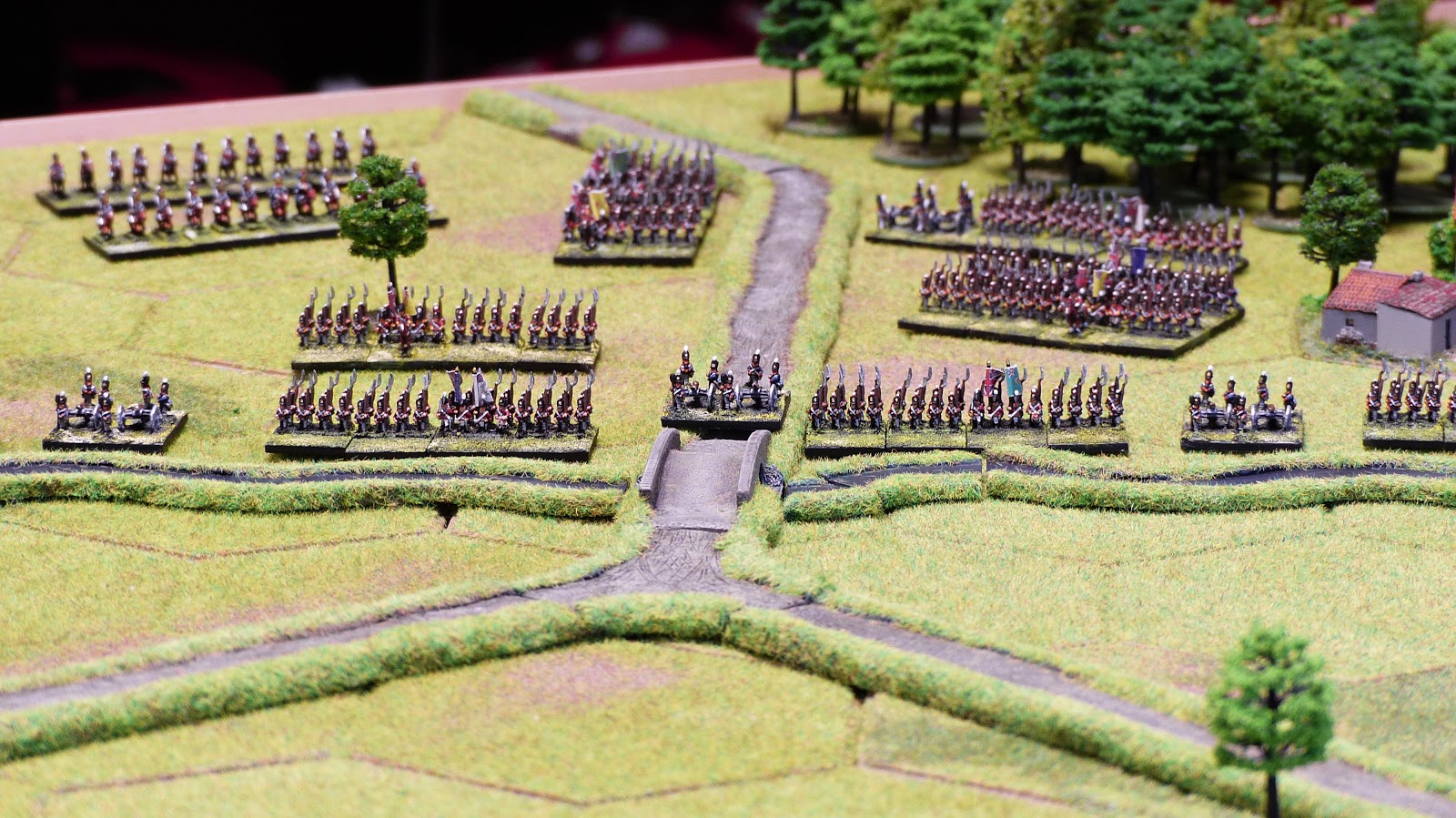
These past few weeks I have been mustering a 6mm British Peninsular army from Baccus.  Painting sessions have not been too regular but I am finally in a position to field a small army for Age of Eagles (AoE in short). I managed 54 infantry stands, eight artillery batteries, and 16 cavalry stands.  At AoE's scale of 360 infantry and 180 cavalry per stand, this would translate into a small army of 19,440 infantry, 2,880 cavalry, and 48 guns - each battery having 6 guns. In terms of figures, each stand contains 8 infantry figures and 3 cavalry figures, so with the artillery that's in the region of 500 figures, all told.

True to form, Baccus make very detailed napoleonic 6mm figures - it's amazing how they manage to fit in so much detail in such small figures - so hats off to Peter and his team for the quality of their product. It is a shame that they are pretty much larger than Heroics and Ros so they are not really compatible but to be honest this lack of compatibility doesn't show that much once the figures are on table. 

Although AoE is brigade level and doesn't really go into the nitty gritty of lower organisation, I still opted to organise the troops into battalions (two stands = 720 men), with four stands to a regiment at 1,440 men.  I made this choice mainly because of the various facing colours which distinguish the different regiments and their regimental flags. The result was a lovely array of coloured regimental standards accompanied by their respective King's Colours.

I staged a few photographs to give an idea of the finished figures.  There's still quite a pile to finish as well as a lot of Spanish and Portuguese to complement the Brits.  Maybe they will feature in a future post.  For the moment, however, here are the Brits that I've managed up to now, stovepipes and all.


Monday, 17 September 2018

Ostrolenka 1807 - A solo effort in 6mm


Having finally set up a decent table in my basement, I decided to try my hand at a solo game.  I used to do a lot of solo gaming in my younger days, mainly because I was under the impression that I was the only nerdy gamer on the island! When I finally discovered the horizon was a bit wider than that, I didn't need to go solo any more.  As anyone who's been to Malta will tell you, distances here are miniscule and although the gaming fraternity is not numerous at all, if you want a game you're only fifteen or twenty minutes away from - not just one - but ALL your opponents. So solo didn't make too much sense any more.  

Now, however, what with all the spanners that life sometimes throws in your works, it's not always possible to meet up. So I thought of setting up a scenario on my table and enjoy a solo game which I could continue at leisure whenever I had some time available. I went for Ostrolenka, an 1807 clash between the French and the Russians a few days after Eylau. The scenario can be found at https://napoleonicscenarios.weebly.com/uploads/2/3/7/7/2377799/ostrolenka_1807.pdf 

It's a relatively small encounter where a Russian force caught a smaller French force unawares at the Polish village of Ostrolenka on the River Narew. The French command, however, soon got wind of the Russian attack and immediately despatched reinforcements to shore up the garrison.  Likewise, the Russians had their own forces converging on the field, giving rise to a short but escalating action. 

All figures are H&R 6mm; rules are Age of Eagles with some house modifications. 

Initial dispositions at 10.30 am, showing the French garrison in and around Ostrolenka with the Russians approaching in the distance.  Note how the town straddles both banks of the River Narew.
Although heavily outnumbered, the French send their light cavalry forward to harass the advancing columns.  On their part, the Russians make for the high ground overlooking the town.
The Russians have reached the foot of the hill and deploy to form a solid front.  Meanwhile to their rear but on the opposite bank, the first French elements approach (upper right)
French dragoons gallop to the rescue !


The first Russian reinforcements arrive on table in Move 3. It is now noon.
Russian dragoons advance on the French lights in a bid to scare them off.
The French light cavalry prudently retire while the Russians occupy the heights in force. On right, the first French cavalry elements approach town. At this point I should mention that the two ponds and the river are frozen over and impassable to cavalry and artillery who can only cross by bridge.
It is soon becoming a race for both sides to rush reinforcements to the front. Oudinot and Suchet's divisions appear behind the town on Move 5 while in the distance more Russian reinforcements pour onto the field. In the centre the lead dragoon elements reach the bridge over the Narew.
The Russian artillery on the hill makes its presence felt as it bombards the approaching French. Meanwhile at upper right, French and Russian artillery trade salvos from across the river while Russian infantry and cavalry reinforcements stream from the rear.
The Russian position on the sand hills overlooking Ostrolenka dishes out a severe artillery bombardment........
......which for the moment the French can only face and absorb defiantly.

It is now 14.30 and despite the intense bombardment, the French have succeeded in getting their cavalry across and put their infantry in a position to assault the Russians on the hill. To the rear, a Russian brigade attempts to cross the Narew to engage the French on the other bank.
As if the artillery wasn't enough of a headache, Oudinot now has to face the threat of Russian hussars too!


Faced with limited options, the French throw caution to the wind and surge up the hill in the face of a muderous hail of canister. The odds are decidedly grim.
A bird's eye view of the french attack and the whole field. Attacking uphill, disordered and having suffered multiple casualties from canister, the French fight the Russians with a -5 deficit......
.....but the dice gods recognise valour when they see it and smile in their favour! (Hint : Green for Russian, blue for French)
Faced with the ferocity of the French infantry, the Russians are forced to withdraw, scrambling to save their precious artillery from the onslaught.
They are quick to react, however, with hussars charging in on the left........
......infantry engaging in the centre.......

.....and heavy dragoons smashing into the French infantry on the right.
The Russians get their own back, routing the first French brigade and rushing headlong into the flank of a second.
In no time at all the hill is bereft of French and all their hard-gotten gains have vanished.
Not one to give up so easily, Savary - the French commander - orders his infantry forward on the left whilst in the centre squares are formed to counter the cavalry threat. Along the bank of the Narew, French cavalry engage the enemy infantry.
French infantry to the assault of the disordered Russian hussars

Massed squares in the centre and cavalry charging in the background.
This second wave of attacks succeed in pushing back both Russian wings. In foreground, French infantry storm back up the hill in a breakthrough charge, having broken the Russian hussars earlier in the move.

Russian infantry at bay
It is now 16.00 and the final move. Having won the initiative, the French press on with their attack and engage the retreating Russian hussars once more.  The Russian cavalry break and retreat again.
Meanwhile, the French dragoons see action at last, outflanking and engaging their Russian counterparts
The defenders are caught in a vice grip, cavalry on one side, infantry on the other. The Russian centre doesn't stand a chance and the entire front line melts away to the rear.
In a final act of desperation, Essen, the Russian commander orders his cossacks forward.  Usually reluctant to engage formed enemy cavalry, the irregulars take up the challenge and hit the dragoons squarely in the flank.
But even the outflanking advantage is not enough and the cossacks are repulsed by the disciplined French cavalry.
The French remain masters of the hill.....
.....while the Russians are forced to retire from the field at day's end.
I feel this is a very difficult scenario for the Russians to win because although they have inital superiority, the French soon build up a formidable force once their reinforcements arrive. It should also be said that the Russians did experience some abysmal dierolls but all in all the balance tips in favour of the French the more time passes. Would love to hear from anyone who managed a Russian victory.........